
Hardware pentest of payment terminals: what gets assessed
What a hardware pentest assesses in payment terminals, ATMs and field devices, how the test is run, and what to ask before you hire one.
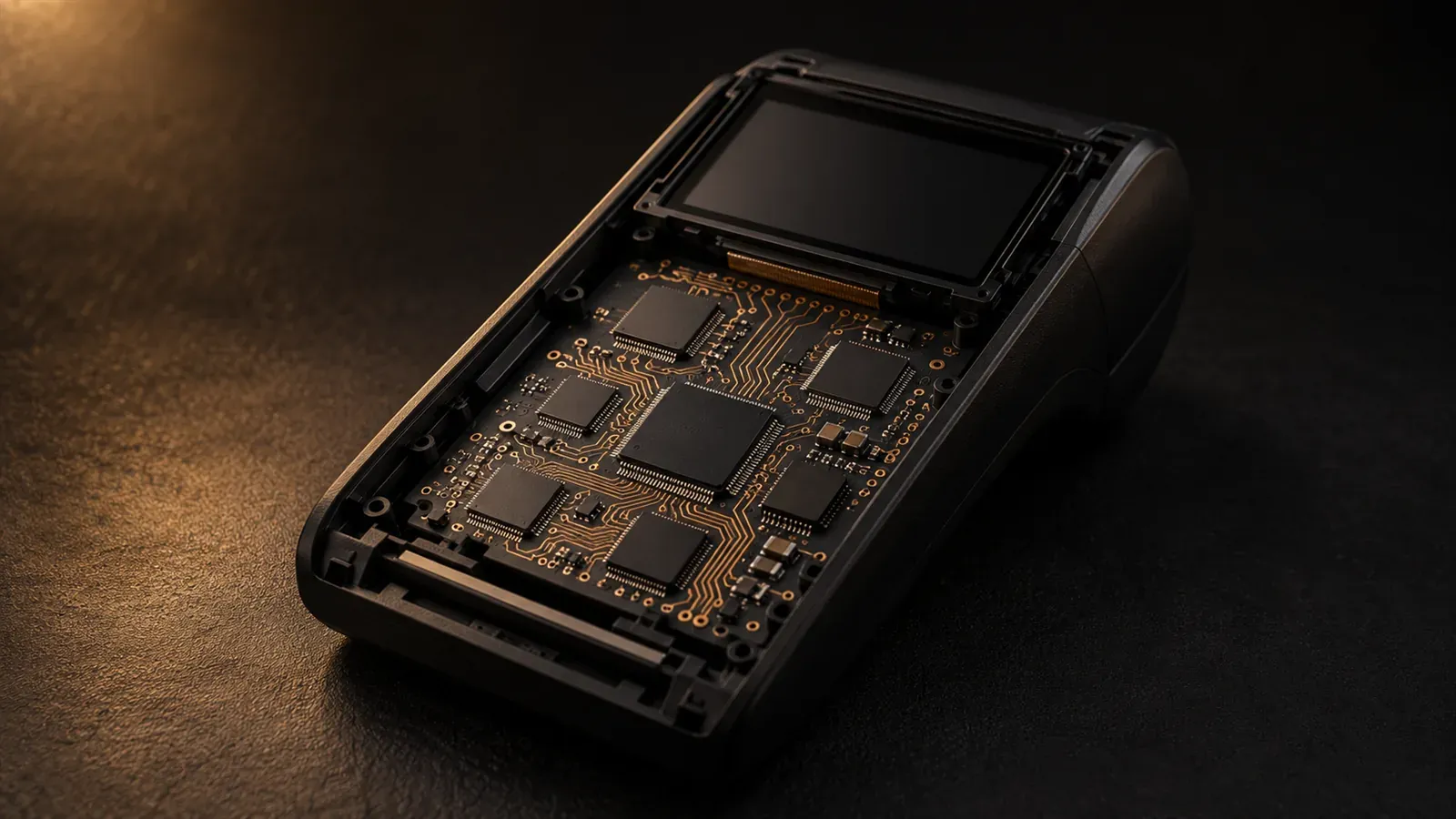
A payment terminal spends its life outside your control. It sits on a shop counter, in a courier’s backpack, in a mall kiosk. Anyone who wants to study one can buy a used unit, take it home and open it at leisure. That is why the security of these devices cannot rest on the network or the server alone: the device itself has to hold out against whoever has it in their hands.
A hardware pentest assesses exactly that. It matters to terminal makers and integrators, to acquirers and payment facilitators that hand out devices, to banks with ATMs, and to any company that puts devices holding secrets in the field.
Why hardware is an attack surface of its own
In a cloud system, an attacker has to get through several layers before touching what matters. With a physical device, they start with access to the board, the memory chips, the connectors, and all the time they want. Protections that work well on a server, such as a strong password or a firewall, do not help if the encryption key can be read straight from the device’s memory.
Certified terminals follow the PCI PTS POI requirements, which cover physical tamper resistance, PIN protection and key management. Certification is an important starting point, but it applies to identified hardware and firmware versions, assessed in a recognized lab. A pentest assesses the device as it reaches the field: with your firmware version, the applications your company installed, the batch’s factory configuration, and the way it talks to your systems.
What the test assesses
A hardware pentest usually looks at five fronts.
Physical protection and tamper detection
Tamper-responsive terminals detect access to their protected areas and erase keys and other sensitive data, as the device’s design specifies. The test checks whether those mechanisms are active on the delivered equipment, whether they respond as expected, and whether the device stops working after a tamper event instead of carrying on.
Debug and maintenance interfaces
During development, boards have interfaces that let the maker read memory and control the processor. In production they should be disabled or protected. The test checks whether any were left open in the batch in the field, and what they would give whoever found them.
Firmware and updates
Firmware is the software that runs on the device. The test checks whether the device accepts only firmware signed by the maker, whether verification happens at every boot and every update, whether old, vulnerable versions can be reinstalled, and whether the firmware file exposes secrets or internal addresses.
Data and key storage
Encryption keys and card data must live in protected areas. Sensitive authentication data, such as the PIN and the card verification code, must not be stored after authorization, except where PCI DSS allows it. The test looks for sensitive data in ordinary memory, diagnostic logs and temporary files, and checks whether keys are unique per device or shared across a whole batch.
Communication with back-end systems
The terminal talks to the acquirer, to the fleet management server and sometimes to the merchant’s phone. The test checks whether those connections are encrypted and mutually authenticated, whether the device accepts a fake server, and whether remote management commands require authorization.
How the test is run
The scope sets the models, the firmware versions and how many units the company provides, since some techniques damage the device. The rules set what may be opened, what must come back working and which staging environments are available. The work happens on the bench, with electronics instruments and firmware analysis, and alongside the staging environment to test communication.
Each finding is recorded with photos, readings and a description of its impact: who could repeat it, with what equipment, and with how much time holding the device. That matters for prioritizing, because a flaw that takes hours in a lab carries a different risk from one anyone can exploit in minutes at the counter.
An illustrative example
This scenario is a composite of findings common in device assessments, not a real customer’s case.
A payment facilitator hands out a certified terminal model with its own sales and management application. It provides three units from the batch in the field for testing.
The physical protection works: when the case is opened, the terminal erases its secrets and shows the tamper message. But a maintenance connector reachable through the battery cover, outside the protected area, answers factory diagnostic commands that were never disabled in that batch. Through it, the application’s configuration can be read, including the address and credential of the fleet management server.
The credential is the same on every terminal. With it, the management server accepts requests from any source, and the staging test shows that a fake device can register and receive configuration updates. Card data stays protected by the terminal’s secure module, but the whole fleet now depends on a secret that is no longer secret.
The fixes follow the order of risk: the maker ships a firmware version that closes the diagnostic connector, the payment facilitator starts generating one credential per device at activation, and the management server starts requiring mutual authentication. The retest confirms all three changes on new units.
What to ask a supplier
- Does the test assess units from the batch in the field, with the firmware and applications my company uses?
- How many units are needed, and which techniques may damage them?
- Does the scope include communication with the acquirer and the fleet management server?
- How is each finding rated for the effort, equipment and time with the device it requires?
- Does the report separate what the maker must fix from what my company must fix?
- Is the retest done on updated units, and how is it documented?
How Leonnes tests hardware
Leonnes’ pentest covers hardware, ATMs and payment terminals: debug interfaces, firmware and device communication, with scope and rules agreed with you before it starts, a weekly status, technical, executive and financial risk reports, and a retest after the fixes. See Leonnes’ pentest.